
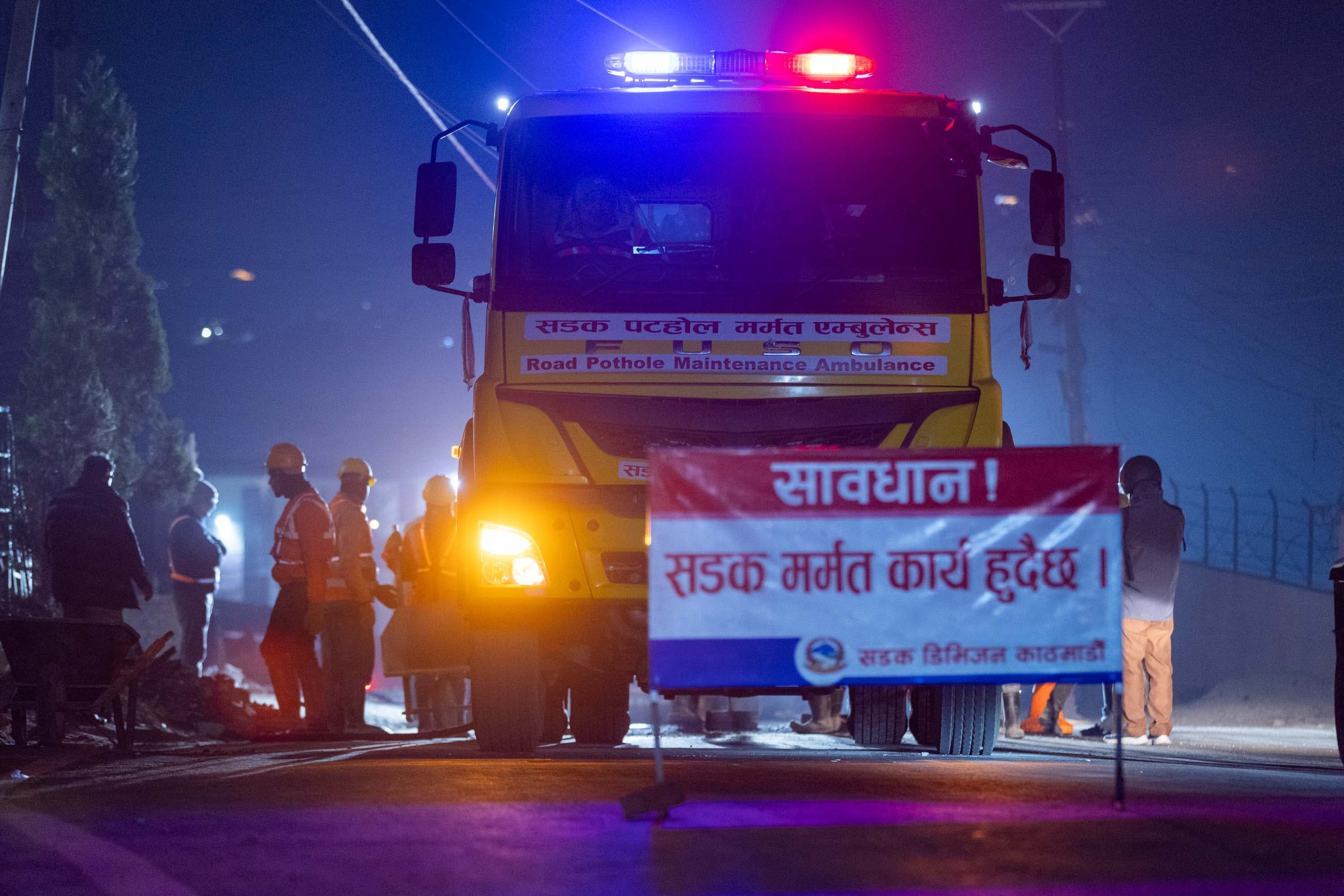
Kathmandu has introduced the first of its kind, road pothole maintenance ambulance, aimed at making urban roads smoother and safer by enabling rapid, on-site repairs. The Road Division Office, Kathmandu, launched the service as part of a major campaign to eliminate potholes in the Ring Road. After completing repairs within the Ring Road, the division has shifted its focus to outer roads where damage is more widespread.
The initiative was officially launched by Minister for Energy, Water Resources and Irrigation, Physical Infrastructure, Transport and Urban Development, Kul Man Ghising. Together with a mobile application to make it easier and faster for individuals or communities to report a road problem. The emergency road ambulance highlights a new effort in Nepal to maintain public roads and acts as a model of accountability by quickly responding to citizens complaints regarding slow road repair times and the appearance of chronically unmaintained potholes.
Division engineers state the emergency road ambulance is outfitted with “state of the art” equipment, including an emulsion heater that reaches 50 degrees Celsius and the ability to spray heated emulsion, cut damaged road sections and clear away potholes using water and air pressure. With this configuration, technicians can conduct effective emergency road repairs during peak traffic times and in emergencies. This service operates 24/7, 365 days a year; therefore, if a road is damaged, a crew will respond immediately for repair.
According to Engineer Ramchandra Phuyal, an engineer assigned to Mulpani, almost all reactive road repairs will occur during the night; however, emergency repairs will also be performed during the day as necessary to maintain public safety. The ultimate goal of this initiative is to eliminate all potholes along a total of 472 km of road.
To further strengthen the process, the division launched the “Road Maintenance Site Rescue” mobile app. Though the public cannot yet submit photos directly through the app, a dedicated team of field staff will identify potholes and relay information for immediate repair. The plan is to eventually allow citizens to upload pothole photos and track repair progress once the system matures.
The Chief District Officer of Kathmandu, Ishwor Raj Poudel, and senior officials, including Secretary Keshav Kumar Sharma and Director General Bijay Jaishi, expressed confidence that the ambulance service will improve transparency and speed in road maintenance. “At this stage, this project will be a pilot in Kathmandu, but if it proves to be successful, we plan to roll this out nationally in all the Road Divisions in Nepal”, says Director Jaishi.
With a trained technical workforce travelling with the road ambulance, having modern equipment aboard, and ready to operate twenty-four hours a day, seven days a week, the road repair service ultimately plans to improve urban infrastructure.