
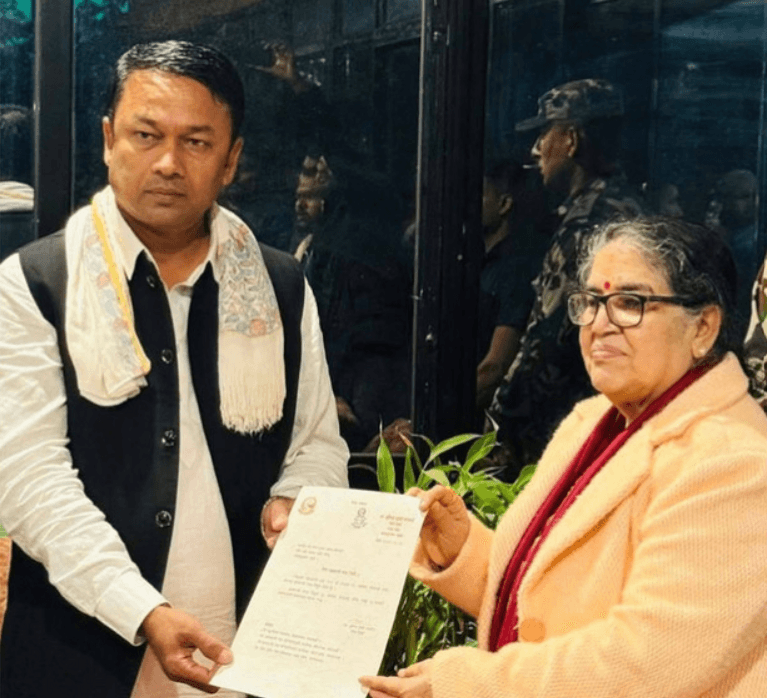
A significant political upheaval has taken place in Madhesh Province after Saroj Kumar Yadav, the CPN-UML parliamentary party leader, was appointed as the new Chief Minister in an unexpected and controversial moment. Provincial Head Sumitra Subedi Bhandari held a secret oath ceremony at a hotel in Bardibas in the early morning hours, leading to a major backlash, street protests, and accusations of constitutional impropriety.
According to sources, Provincial Head Bhandari departed Janakpur at about 4 am on Monday, stating to others that he was feeling unwell and travelling to Kathmandu for treatment. However, Acting Chief Jitendra Sonal, who ran a caretaker administration, personally wished him a speedy recovery before he left. Instead of going to Kathmandu, Provincial Head Bhandari headed to Bardibas, where he performed an oath ceremony for UML party leader Saroj Kumar Yadav at about 5:20 am at Hotel Panas Cottage.
The occurrence took place as part of Article 168 (3) in Nepal's constitution. This clause allows the leader of the largest political party to build a government even if a majority is not established. Apart from that development, UML MP Laxman Das Tatma, Bimala Ansari, Nepal Samajbadi Party, and ministers (for example, Rastriya Prajatantra Party's Kanchan Biccha) took their oath.
This twist came amid ongoing negotiations in Janakpur, where a seven-party alliance including Nepali Congress, Maoist Centre, Unified Socialist, LSP, Janamat, JSP, and Nagarik Unmukti Party was urging Bhandari to form a majority-backed coalition government under Article 168(2). Just a day earlier, Bhandari had met these parties and legal experts, assuring them of a careful, constitutional process. But after leaving the meeting, claiming she was going to see a doctor, she secretly appointed a UML-led government in Bardibas shocking both political leaders and the public.
In Janakpur, the news of the secret appointment quickly led to protests outside the Madhesh Bhawan, where the Provincial Head’s Office is located. Leaders and supporters of the seven-party alliance came out in numbers, chanting slogans calling Bhandari’s action anti-federal, unconstitutional, and politically motivated. Protesters reportedly also vandalised parts of the office compound, demanding the Provincial Head’s immediate resignation for misusing her power and undermining the intent of provincial autonomy.
Criticisers also pointed out that Mrs Bhandari was not following constitutional processes by doing official business outside of the relevant provincial headquarters. Moreover, they contended that what she had done was represent a worrying norm where Provincial Heads could overtly abuse the neutrality and constitutional role of the Provincial Head’s office, and put political interests above the best interests of their province.
The controversy has sparked turmoil within the new government as well. RPP Chairman Rajendra Lingden publicly ordered party member Kanchan Biccha to withdraw from the UML-led provincial cabinet, calling her participation unauthorized and a serious breach of party discipline. He warned that failure to comply would lead to disciplinary action under the party’s constitution.
Lingden's message on social media stated, “The RPP's participation in the Madhesh provincial cabinet has come to our serious attention. This is an act of serious violation of party discipline. The member is instructed to withdraw immediately from the provincial cabinet. Otherwise, action will have to be taken per party constitution.”
At the same time, political experts and insiders have also raised constitutional questions over the incident. Some have specifically questioned the legality of appointing a Chief Minister outside the provincial capital, as well as the lack of transparency and consultation involved in Bhandari’s decision. The incident has again opened rancorous debate over the unclear powers of provincial heads and the imperative of accountability in Nepal’s federalism.
Although protests continue in Janakpur and opposition parties rally their members to oppose the call, the political climate in Madhesh Province remains tenuous and uncertain. Regardless of the Chief Minister Saroj Kumar Yadav remains as Chief Minister or not, it will depend on issues that arise shortly within the province assembly and if there will be litigated.