
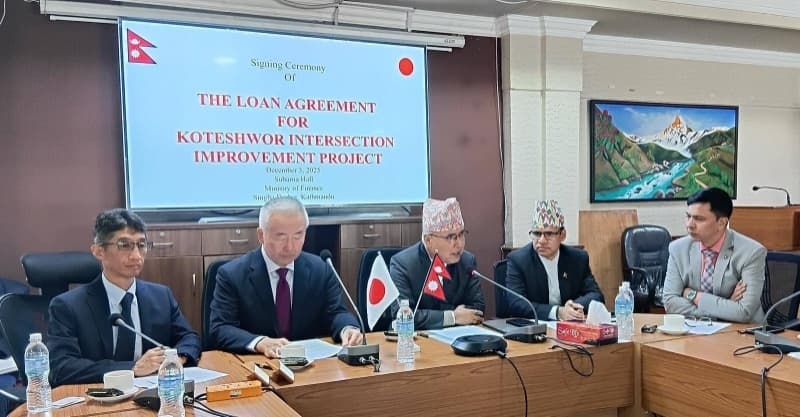
An agreement between Nepal and Japan formalises a major loan agreement for Official Development Assistance (ODA), which will help reduce high traffic congestion in one of Kathmandu Valley’s busiest routes. The fund for this agreement amounts to 34.49 billion Japanese Yen (or about Rs 31.76 billion) and will be used for the Koteshwor Intersection Improvement Project, which aims to improve the movement of residents in the city of Kathmandu and surrounding areas.
The Exchange of Notes was exchanged between Dr. Ghanashyam Upadhaya (Finance Secretary) and Ambassador Maeda Toru of Japan, while the loan agreement was signed by Dhani Ram Sharma (Joint Secretary of Finance) and Matsuzaki Mizuki (Chief Representative of JICA Nepal). The presence of Finance Minister Rameshore Prasad Khanal at this ceremony indicates the government's commitment to the importance of this project for improving Urban Infrastructure within Nepal.
Improvements to the intersections of Tinkune, Koteshwor, and Jadibuti will involve the construction of grade-separated structures (underpasses and flyovers) at some of the most congested locations in the Valley; those intersections are important gateways between the core of the Kathmandu Valley and regional highways, including the BP Highway. This project will also reduce traffic congestion at these intersections by improving traffic flow and allowing greater vehicle throughput by providing more efficient access to and from these highways.
Officials emphasized that the project will contribute to long-term economic growth, improve urban liveability, and strengthen the Valley’s infrastructure resilience. The initiative is being executed under the Ministry of Physical Infrastructure and Transport and implemented by the Department of Roads. The total project duration is eight years.
Nepal's project financing structure is based on Japan's concessional loan model with a 40 year repayment period, 10 year grace period and a very low (0.2%) annual interest rate designed to help support Nepal's ability to develop large-scale infrastructure projects without a significant financial burden immediately after obtaining the funding.
At the signing ceremony, JICA Nepal Chief Representative Matsuzaki Mizuki expressed his belief that the success of this project depends on the cooperation of the various agencies of the Government of Nepal, Local Government and partner organizations and stated that the Government of Japan is committed to supporting the development of Nepal's transport sector through the long-term bilateral relationship.
According to Ambassador Maeda Toru, this project supports Japan's goal of promoting Nepal's urban development and improving the quality of life for the citizens of Nepal. He stated that he believes these infrastructure improvements would result in a significant decrease in Kathmandu's persistent traffic congestion.Finance Minister Rameshore Prasad Khanal has called this infrastructure project an important investment that will significantly improve one of the Valley's most congested areas. The continued partnership between Nepal and Japan has been critical to strengthening Nepal's developmental goals.
Historically, the Koteshwor–Jadibuti corridor has faced many problems related to increased traffic from multiple districts, urban population increases, and the lack of capacity of existing road infrastructure. With the new underpasses and flyovers, commuters will have a much easier way to travel without interruption from traffic congestion; travelers will experience fewer delays while riding along this corridor; and both local and long-distance commercial vehicles will be able to fit into the area better.
When complete, this project will be a model for future developments of transport infrastructure in Nepal and will further solidify Japan's position as a leading development partner for Nepal.