
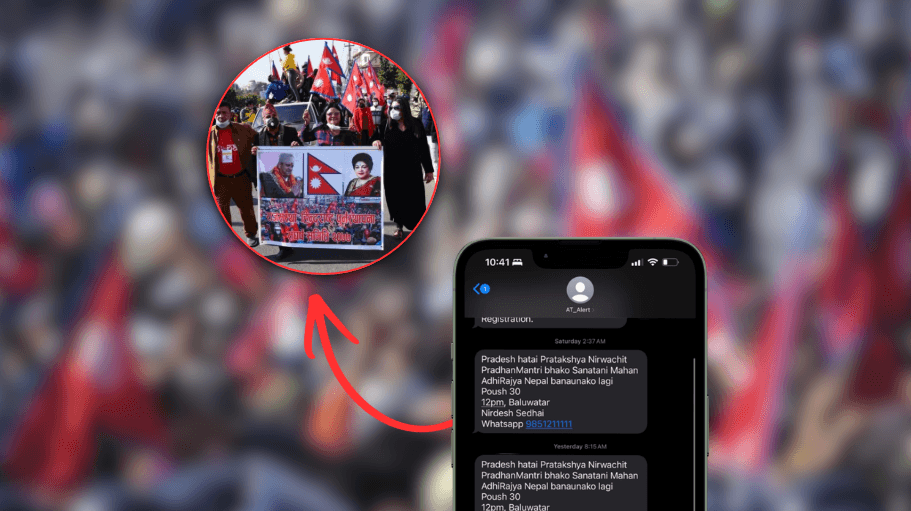
Millions of mobile users across Nepal received unsolicited SMS messages through AT Alert and SI Alert platforms, promoting a campaign calling for the abolition of provinces and the establishment of a directly elected prime minister under a “Sanatani kingdom.” urging them to participate in a royalist protest scheduled for Poush 30, triggering concerns over mass data misuse and weak regulation of SMS gateway services.
Investigations show that the SMS were transmitted using gateways operated by Akash SMS and SI Alert, under the sender name “Nirdesh Sedhai.” According to Akash SMS Sales and Marketing Manager Rajan Koirala, the platform had been provided to Vedvyas Enterprises Pvt Ltd under a commercial agreement meant strictly for business promotion.
Moreover, Koirala said the company violated the agreement by sending political and controversial messages late at night. Once the misuse was detected, the service was blocked, but by then, around 50 lakh SMS had already been delivered. He acknowledged the scale of the transmission but said the service provider did not know how the recipient phone numbers were obtained.
However, information technology experts argue that randomly generating phone numbers would not allow such a high delivery rate. They say datasets of this scale can only originate from large databases held by banks, telecom companies, e-commerce platforms, or government agencies, raising deeper concerns about data security and institutional accountability.
Legal experts have described the incident as a serious breach of personal privacy and telecommunications law. Digital rights activist and advocate Baburam Aryal said sending mass messages without consent violates the Privacy Act, Advertising Act, and Telecommunications Act, adding that regulators should revoke the licenses of companies involved. “This is a clear violation of personal privacy and telecom laws,” he said, calling for immediate action by the Nepal Telecommunications Authority.
The Nepal Telecommunications Authority chairman, Bhupendra Bhandari, confirmed that he too received the message and questioned how phone numbers were collected without consent. Meanwhile, Central Investigation Bureau chief AIG Dr Manoj Kumar KC said legal action would be taken if the incident is found to incite unrest or violate digital rights.